Wednesday, 13 November 2013

Todorov's Theory

Todorov was a Bulgarian struscruralist linguist publishing influential work on narrative from the 1960s.

Todorov suggested that stories begin with an equilibrium or status quo where any potentially opposing forces are in balance. Todorov came up with a theory that most narrative storylines include similar conventions, his theory argued that many storylines had 5 common conventions and that many story’s follow these conventions.

This is disrupted by some event, setting in chain a series of events. Problems are solved so that order can be restored to the world of the fiction. 

Todorov suggested that conventional narratives are structured in five stages:

1. A state of equilibrium (stability) at the start 
2. A disruption of the equilibrium by some action 
3. A recognition that there has been a disruption 
4. An attempt to repair the disruption 
5. A reinstatement of the equilibrium

This type of narrative structure is very familiar to us and can be applied to many 'mainstream' film narratives. Titanic is an example that is similar to Todorov's theory. 

Thursday, 10 October 2013

Habermas Theory


The public sphere is an area in social life where individuals can come together to freely discuss and identify societal problems, and through that discussion influence political action. It is "a discursive space in which individuals and groups congregate to discuss matters of mutual interest and, where possible, to reach a common judgement”. The public sphere can be seen as "a theatre in modern societies in which political participation is enacted through the medium of talk" and a "realm of social life in which public opinion can be formed”. The study of the public sphere centres on the idea of participatory democracy, and how public opinion becomes political action. The basic belief in public sphere theory is that political action is steered by the public sphere, and that the only legitimate governments are those that listen to the public sphere.

Habermas stipulates that, due to specific historical circumstances, a new civic society emerged in the Eighteenth century. Driven by a need for open commercial arenas where news and matters of common concern could be freely exchanged and discussed - accompanied by growing rates of literacy, accessibility to literature, and a new kind of critical journalism - a separate domain from ruling authorities started to evolve across Europe.


The public sphere was well established in various locations including coffee shops and salons, areas of society where various people could gather and discuss matters that concerned them. The coffee houses in London society at this time became the centres of art and literary criticism, which gradually widened to include even the economic and the political disputes as matters of discussion.
 
As Habermas argues, in due course, this sphere of rational and universalistic politics, free from both the economy and the state, was destroyed by the same forces that initially established it. The growth of capitalistic economy led to an uneven distribution of wealth, thus widening the economic polarity. This results in limiting access to the public sphere and the political control of the public sphere was inevitable for the modern capitalistic forces to operate and thrive in the competitive economy.

According to Habermas, a variety of factors resulted in the eventual decay of the public sphere, including the growth of a commercial mass media, which turned the critical public into a passive consumer public; and the welfare state, which merged the state with society so thoroughly that the public sphere was squeezed out. It also turned the "public sphere" into a site of self-interested contestation for the resources of the state rather than a space for development of a public-minded rational consensus.


Main Quotes

“By the ‘public sphere’ we mean first of all the realm of our social life in which something approaching public opinion can be formed,” writes Habermas. “Citizens behave as a public body when they confer in an unrestricted fashion – that is, with the guarantee of freedom of assembly and association and the freedom to express and publish their opinions– about matters of general interest.”

This publishes of representation was not constituted as a social realm, that is, a sphere; rather, it was something like a status attribute, if this term may be permitted.”

“The world has grown too complex for this barely concealed unilateralism.” - Habermas

I do think it is very important not to forget that society is not only depending on technologies and the knowledge feeding into new technology in society, is depending on a proper continuation and
reconstruction of its own connections.”

“ In its clash with the arcane and bureaucratic practices of the absolutist state, the emergent bourgeoisie gradually replaced a public sphere in which the ruler’s power was merely represented before the people with a sphere in which state authority was publicly monitored through informed and critical discourse by the people"

Applying his theories to we-media

·         He advocates free speech and creative discussion to create political change. This can be related to Kony 2012, who used a video to try and create change in Uganda.

·         ‘Occupy Southend’ – people campaigning outside the Odeon; example of people working together for change through collaborative discussion.

·         ‘Ding Dong the Witch is Dead’ à People coming together for a common cause. Although arguably, this wasn’t effective.

·         Arab Springs ‘accelerated communication opens up entirely new possibilities for organizing activities and for large-scale political mobilizations of widely dispersed addressees.’ – People communicating quickly through Twitter to bring about an uprising.


Tuesday, 1 October 2013

David Gauntlett- Web 2.0

David Gauntlett is a British sociologist and media theorist. He specializes in studying contemporary media audiences, the every making and sharing of digital media, and the role of such media in self-identity and self-expression. Web 2.0 has enabled all kinds of people to be creative, to share the products they've made, to collaborate with others and be producers as well as consumers.

Background information

  • Gauntlett graduated from the University Of York in Sociology in 1992
  • In 2006 he joined the School of Media, Arts and Design as a Professor of Media and Communications
  • He focused on the way digital media is changing the experience of media in general.

Media Studies 2.0

  • Gauntlett published 'Media Studies 2.0' online in 2007, which argues that classic media studies fails to define when the categories of 'audiences' and 'producers' unit, and that new, altered teaching methods are needed.
  • He states that because of web 2.0, we, as audiences, can become our own producers. Websites such as YouTube have allowed us to do this. Through this we can create our own identity and even influence other peoples.
  • Through this, gender identity for example, has become less constricted to previous representations. Web 2.0 allows us to create our own unique identity that doesn't necessarily follow traditional understandings of gender. The ability and freedom that web 2.0's allowed means it is not far more acceptable to be different and accepted for our individuality.
  • A proposition to rework audience studies was put forward by Gauntlett in 2008. This argues that audiences change to become more so active than passive towards media. These ideas are developed further in 'Making is Connecting'.
  • It is almost impossible to tell how an audience is going to react to a particular media product. This may change how the particular product is done. A product might evolve into something more similar to a different media product that has already had a great reaction from the audience viewing it.

  • Media 2.0 focuses on everyday meaning produced by the diverse array of audience members
  • The concept of Web 2.0 blew up in 2005 after Tim O'Reilly wrote a brilliant article on the subject and published it on the web.
  • This was before the most well-known Web 2.0 platforms had really taken off. But lately there has been a lot of criticism about the Web 2.0 giants. Facebook has seen its stock price cut in half. Twitter and other social media platforms have come under recent criticisms as well.
  • The core parts of Web 2.0, according to Martin Kelly are the following:
1. Relying on "hard to recreate" content pieces that "get richer as more people use them".
2. "Trusting users as co-developers".
3. "Utilitizng the knowledge of the group and collective".
4. "Leveraging the long tail through customer self-service".
5. Focus on providing services, not a piece of software, and remaining cost-effective.
  • These five core concepts are still highly relevant to any Web 2.0 platform today. Even with recent downturns on the stock market or elsewhere, the biggest tech giants today like Google, Amazon, Apple, Facebook, Twitter, and a few others all adhere to these principles.
I agree with David Gauntlett that individuals can now be consumers as well as producers. In relation to my documentary on the Brighton Marathon, many runners have blogged and filmed their journey in the training process and the run up to the marathon. This has helped other hopeful runners learn what is involved and informs them with training tips.

Wednesday, 25 September 2013

Stuart Hall - Reception Theory

Stuart Hall's Reception Theory believes the media producer will encode the text in a certain way to convey a message. It is the way the audience receive and interpret a text. A text is encoded by a producer, and decoded by the readers. The theory emphasises the readers reception of a text and how individual circumnstatnces, like gender, age and ethnicity affect their reading.


The Preferred/Dominant Reading - is that the reader fully shares the text's code and accepts and reproduces the preferred reading (a reading which may not have been the result of an conscious intention on the part of the author) For example - A McDonalds advert, the producer will want the audience to think "Mmmm I fancy a McDonalds, lets go buy one".

The Oppositional Reading - some audience members will think the opposite of the dominant reading. For example - A McDonalds advert, the audience will think "Ew, I am not eating a McDonalds, it is made with horse meat".


The Negotiated Reading - is where the audience will accept some of the preferred reading, but will refine their views based on their own experiences and opinions. For example - "I really fancy a McDonalds, but I know how unhealthy it is so I better just have one occasi
onally.


Rather then just exploring how texts make meaning, for Hall, the meaning of the text is not inherently in the text itself. From this Hall claimed that no amount of analysis can find the texts actual one meaning because different people who encounter the text will make different interpretations.

This can be applied to other media formats such as films, TV shows etc, as we as an audience don't all like the same characters portrayed in those media texts but we are all able to see the same representations. The technical and symbolic codes which construct the representations we perceive are the same as the denotation is often the same. The thoughts that the producers or directors want us to think and what we actually think might be two different things. This reading, according to Hall depends on our social positioning an example is the level of our education and experience and what are occupations are.


Thursday, 12 September 2013

Uses And Gratifications Theory

  • During the 1960s, as the first generation to grow up with television became grown ups, it became increasingly apparent to media theorists that audiences made choices about what they did when consuming texts. Far from being a passive mass, audiences were made up of individuals who actively consumed texts for different reasons and in different ways.

  • Blumer And Katz - 1974
  • They expanded an earlier theory by Lasswell in 1948
  • He suggested that media texts had the following functions for the audience:
  • Surveillance
  • Correlation
  • Entertainment
  • Cultural transmission
  • Theory says that the audience chose their media text to fulfill different needs that they have

  • Bulmer And Katz suggested the following reasons to choose a text:
  • Diversion - escape from everyday problems and routine
  • Personal Relationships - using the media for emotional and other interaction - eg substituting soap operaas for family life
  • Personal Identity - finding yourself reflected in texts, learning behaviour and values from texts
  • Surveillance - information which could be useful for living - eg weather reports, financial news, holiday bargains
Criticisms
  • The use of retrospective 'self-reports' has several limitations. Viewers may not know why they chose to watch what they did, or may not be able to explain fully. The reasons which can be articulated may be the least important. People may simply offers reasons which they have heard others mention. More promising might be the study of people's engagement with media as it happens.

Two Step Flow Theory


  • A slightly more sophisticated version of the Hypodermic Syringe Theory. 
  • It says that the message is transmitted to the audience via a small group of 'opinions leaders'.
  • Opinion leaders have an influence over the general audience.
  • General audience receive the media message, filtered through the thoughts and opinions of the opinion leaders.
  • Opinion Leader is a leader for a certain group who gives details and information to lesser active persons in the group. They interpret the information to their own group. But one thing the Opinion leader is a leader only for their own group not for all.
  • Eg - Opinion Leader may be a celebrity on Twitter or other social media platforms.
Critics:
  • Researchers found substantial evidence that initial mass media information flows directly to people on the whole and is not relayed by opinion leaders.
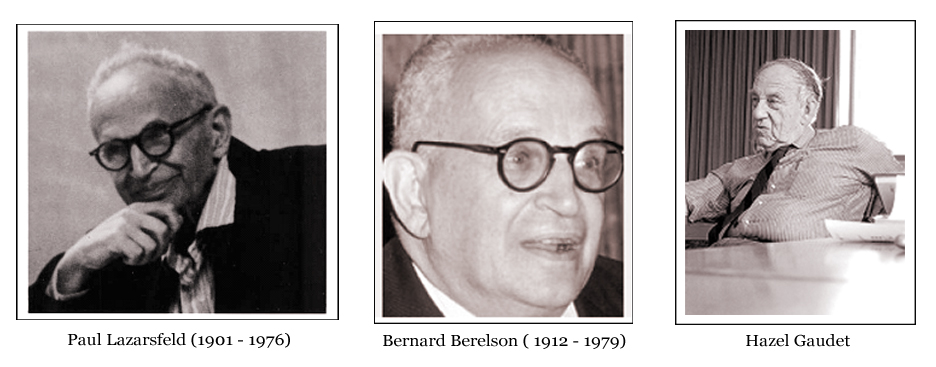
  • The two-step hypothesis does not adequately describe the flow of learning. Lazarsfeld and his associates in the 1940 election study were unable to determine the specific flow of influence.
  • Today most of the advertising researches are based on this theory. Especially opinion leaders role in the society as well as in home to which helps to improve the market with less efforts.
For example, for documentaries, a well-known, famous icon may produce a documentary and become an opinion leader. They may have an influence over the general audience, for example, young girls wanting an image like a famous celebrity.

Wednesday, 11 September 2013

Hypodermic Syringe Model - Audience Theory - 1920s


  • The hypodermic syringe theory implies that the mass media has a direct, immediate and powerful effect on its audiences. 
  • It was the first model to try to explain the effect the media has on the audience. 
  • The mass media in the 1940s and 1950s was perceived as a powerful influence on behaviour change. It says that the media 'inject' meaning into the audience, who then passively accept what they have been told. 
  • This theory assumes that the audience is passive and that the experience, intelligence and opinions of each individual is not relevant. 
  • This theory is very outdated, but still sometimes assumed to be true by the government and the tabloid press. 
  • According to Katz and Lazarfeld, the model is rooted in 1930s behaviourism and is concerned by many to be no longer exist.
  • The model suggests there is a direct link between media and the behaviour or attitudes of the audience. Young audiences are seen to be the most vulnerable, because is an agent of socialisation for them, and so are more likely to be influenced by the content.
  • Some people argue that the boys who murdered Jamie Bulger were influenced by what they saw in the film, Childs Play 3. This reinforces the idea that people are influenced greatly by the media messages that they receive.
  • Bobo Doll Experiment - 36 boys and 36 girls, between the ages of 3 and 6. Study 1: Child was playing with toys while an adult in the corner started hitting the Bobo Doll. Children were taken into a room with a Bobo doll. Study 2: Children were left alone with sets of aggressive and non-aggresive toys to play with.

For example, for documentaries, the audience may believe everything that is being narrated is true, even though it may come from unreliable sources.