Wednesday, 25 September 2013

Stuart Hall - Reception Theory

Stuart Hall's Reception Theory believes the media producer will encode the text in a certain way to convey a message. It is the way the audience receive and interpret a text. A text is encoded by a producer, and decoded by the readers. The theory emphasises the readers reception of a text and how individual circumnstatnces, like gender, age and ethnicity affect their reading.


The Preferred/Dominant Reading - is that the reader fully shares the text's code and accepts and reproduces the preferred reading (a reading which may not have been the result of an conscious intention on the part of the author) For example - A McDonalds advert, the producer will want the audience to think "Mmmm I fancy a McDonalds, lets go buy one".

The Oppositional Reading - some audience members will think the opposite of the dominant reading. For example - A McDonalds advert, the audience will think "Ew, I am not eating a McDonalds, it is made with horse meat".


The Negotiated Reading - is where the audience will accept some of the preferred reading, but will refine their views based on their own experiences and opinions. For example - "I really fancy a McDonalds, but I know how unhealthy it is so I better just have one occasi
onally.


Rather then just exploring how texts make meaning, for Hall, the meaning of the text is not inherently in the text itself. From this Hall claimed that no amount of analysis can find the texts actual one meaning because different people who encounter the text will make different interpretations.

This can be applied to other media formats such as films, TV shows etc, as we as an audience don't all like the same characters portrayed in those media texts but we are all able to see the same representations. The technical and symbolic codes which construct the representations we perceive are the same as the denotation is often the same. The thoughts that the producers or directors want us to think and what we actually think might be two different things. This reading, according to Hall depends on our social positioning an example is the level of our education and experience and what are occupations are.


Thursday, 12 September 2013

Uses And Gratifications Theory

  • During the 1960s, as the first generation to grow up with television became grown ups, it became increasingly apparent to media theorists that audiences made choices about what they did when consuming texts. Far from being a passive mass, audiences were made up of individuals who actively consumed texts for different reasons and in different ways.

  • Blumer And Katz - 1974
  • They expanded an earlier theory by Lasswell in 1948
  • He suggested that media texts had the following functions for the audience:
  • Surveillance
  • Correlation
  • Entertainment
  • Cultural transmission
  • Theory says that the audience chose their media text to fulfill different needs that they have

  • Bulmer And Katz suggested the following reasons to choose a text:
  • Diversion - escape from everyday problems and routine
  • Personal Relationships - using the media for emotional and other interaction - eg substituting soap operaas for family life
  • Personal Identity - finding yourself reflected in texts, learning behaviour and values from texts
  • Surveillance - information which could be useful for living - eg weather reports, financial news, holiday bargains
Criticisms
  • The use of retrospective 'self-reports' has several limitations. Viewers may not know why they chose to watch what they did, or may not be able to explain fully. The reasons which can be articulated may be the least important. People may simply offers reasons which they have heard others mention. More promising might be the study of people's engagement with media as it happens.

Two Step Flow Theory


  • A slightly more sophisticated version of the Hypodermic Syringe Theory. 
  • It says that the message is transmitted to the audience via a small group of 'opinions leaders'.
  • Opinion leaders have an influence over the general audience.
  • General audience receive the media message, filtered through the thoughts and opinions of the opinion leaders.
  • Opinion Leader is a leader for a certain group who gives details and information to lesser active persons in the group. They interpret the information to their own group. But one thing the Opinion leader is a leader only for their own group not for all.
  • Eg - Opinion Leader may be a celebrity on Twitter or other social media platforms.
Critics:
  • Researchers found substantial evidence that initial mass media information flows directly to people on the whole and is not relayed by opinion leaders.
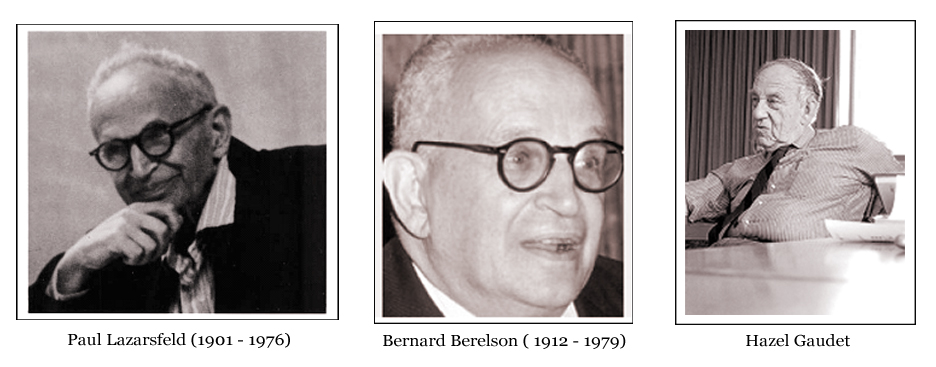
  • The two-step hypothesis does not adequately describe the flow of learning. Lazarsfeld and his associates in the 1940 election study were unable to determine the specific flow of influence.
  • Today most of the advertising researches are based on this theory. Especially opinion leaders role in the society as well as in home to which helps to improve the market with less efforts.
For example, for documentaries, a well-known, famous icon may produce a documentary and become an opinion leader. They may have an influence over the general audience, for example, young girls wanting an image like a famous celebrity.

Wednesday, 11 September 2013

Hypodermic Syringe Model - Audience Theory - 1920s


  • The hypodermic syringe theory implies that the mass media has a direct, immediate and powerful effect on its audiences. 
  • It was the first model to try to explain the effect the media has on the audience. 
  • The mass media in the 1940s and 1950s was perceived as a powerful influence on behaviour change. It says that the media 'inject' meaning into the audience, who then passively accept what they have been told. 
  • This theory assumes that the audience is passive and that the experience, intelligence and opinions of each individual is not relevant. 
  • This theory is very outdated, but still sometimes assumed to be true by the government and the tabloid press. 
  • According to Katz and Lazarfeld, the model is rooted in 1930s behaviourism and is concerned by many to be no longer exist.
  • The model suggests there is a direct link between media and the behaviour or attitudes of the audience. Young audiences are seen to be the most vulnerable, because is an agent of socialisation for them, and so are more likely to be influenced by the content.
  • Some people argue that the boys who murdered Jamie Bulger were influenced by what they saw in the film, Childs Play 3. This reinforces the idea that people are influenced greatly by the media messages that they receive.
  • Bobo Doll Experiment - 36 boys and 36 girls, between the ages of 3 and 6. Study 1: Child was playing with toys while an adult in the corner started hitting the Bobo Doll. Children were taken into a room with a Bobo doll. Study 2: Children were left alone with sets of aggressive and non-aggresive toys to play with.

For example, for documentaries, the audience may believe everything that is being narrated is true, even though it may come from unreliable sources.